Skip to Main Content

Family Activities

Family-friendly events for families with children of all ages. Looking for Summer Camp information, visit our Summer Camp page

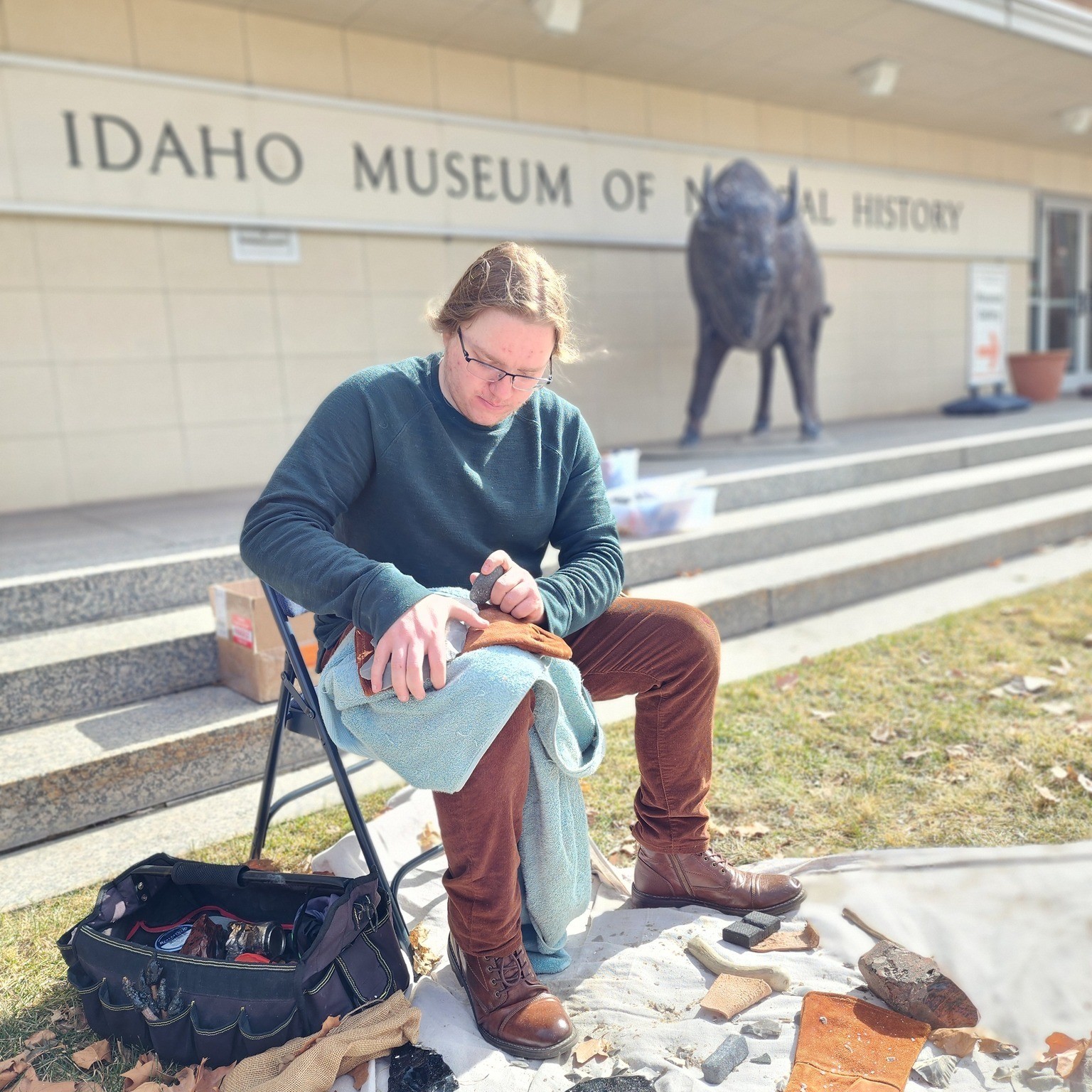
Learn about Flintknapping

A man breaking stone to create a stone tool

Select Saturday or Sunday

1 to 3 p.m.

Admission

James Kickham, Museum Intern, will demonstrate flintknapping techniques in the Museum Discovery Room. James began his experiments in flintknapping at Idaho State University when he was in high school. He developed those skills from multiple technical courses and mentors while honing them working for the IMNH. He has also given lectures and presentations on stone tools while working as a Park Ranger.

  • February 21
  • March 1, 7, 14, 21, 29

Swimming through the time of the Dinosaurs

Gary McGaughey at a podium presenting research

February 25

Noon

Free
Throughout the Mesozoic Era, multiple clades of reptiles adapted marine lifestyles and filled a variety of important aquatic ecological niches. During this presentation, Gary McGaughey (Ph.D. Candidate) will explore the incredible diversity of marine reptiles and highlight some of the most interesting animals that swam in the world's oceans during the time of the dinosaurs. In addition to marine reptile diversity, Gary will discuss the evolutionary relationships between these groups and explain the methods he is using in his dissertation to elucidate these relationships.

Bloom, Discover, and Roam in the Sagebrush Steppe! 

Bloom discover roam Feb 28 1 to 3 pm

February 28, 2026

1 to 3 pm

Free

Join us for a free, fun, family-friendly afternoon of hands-on learning with Sagebrush Steppe Land Trust (SSLT)!  SSLT designed the activities especially for kids and families and features three engaging stations you can explore at your own pace.

What:
• Play a life-sized board game exploring wildlife migration routes
• Learn about sagebrush steppe wildlife by creating your own “critter catcher” with an origami foldable
• Learn about pollinator-friendly plants by making sunflower art and planting your own sunflower to take home

Your event or program registration is transferable

If you are unable to attend a workshop or program, you may transfer your registration to another person or to a different date for the same workshop or program. Transfers may take place up to one week prior to the program date. Please email your request to us. Include the order number and name of the person originally registered for the program and the name and contact information of the person taking your place.

If you must cancel:

  • If you request a refund 15 or more days prior to your workshop, you will receive a full refund
  • If you request a refund 8—14 days prior to your workshop, you will receive a 50% refund
  • If you request a refund 7 or fewer days prior to your workshop, no refund will be issued
  • If a camper or anyone in their immediate family is feeling ill, please stay home! Parents or guardians can email imnh@isu.edu or call 208-282-3168, and we will work to place you in another day of camp or workshop when you are feeling better.

Scanning the Skeleton

Lunch & learn at the Museum with a cartoon sandwich enjoying the lecture

March 11

Noon

Free
How 3D Technology Is Transforming Skeletal Research and Preservation
How do museums and universities preserve human skeletal remains while still making them accessible for research and education? Spencer Moore, ISU Anthropology Graduate Student, presents an ongoing project at ISU that is using 3D scanning technology to build a virtual skeletal collection. By digitizing human remains, researchers can minimize physical handling, protect fragile specimens, and expand access for students and scholars, while rethinking ethical responsibilities surrounding human remains in academic collections.

Looking at "nestling down"

Lunch & learn at the Museum with a cartoon sandwich enjoying the lecture

April 30

Noon

Free
What it can tell us about dinosaur feathers?
What were dinosaur feathers like? How did they evolve? These are recurring questions that paleontologists have been analyzing since they first knew that some dinosaurs were fluffy. To answer these questions, they often look at the dinosaurs' living relatives, birds. But there is one specific type of bird feather that might hold the most clues for us: the fluffy down that covers chicks.  In this talk, Carmen Urban, Biology PhD Candidate, will look in-depth at nestling down and see what it can tell us about feather evolution in birds and dinosaurs.