
Stress and Your Brain
By Marijke Johnson
March 11, 2026
Your heart is pounding in your chest. Your palms are slick with sweat. You feel a knot in your stomach, and you feel the beginning of a headache pounding in your skull. You are no stranger to this feeling - you are stressed.
Your heart is pounding in your chest. Your palms are slick with sweat. You feel a knot in your stomach, and you feel the beginning of a headache pounding in your skull. You are no stranger to this feeling - you are stressed.
We all deal with stress. From the exam that constantly nags at your thoughts, the bills that constantly pile up and make it hard to sleep, or even the family situation that makes you mindlessly overeat, stress is a normal part of life, and we all experience it to varying degrees. This raises an important question: if stress is so negative, why do we experience it at all?
Stress actually exists for our benefit. Stress is a mechanism our body uses to protect us in potentially harmful situations and alerts us when there might be a threat to our safety. Our body activates a series of coordinated physiological responses that are ultimately supposed to protect us from harm. Many people refer to this stress response as our “fight-or-flight” response. In short-term or life-threatening situations, stress can be both necessary and beneficial (Radley JJ et al, 2015).
Unfortunately, despite our body’s good intentions to protect us, stress can cause many problems in our lives when it is not well controlled. Many individuals struggle with chronic stress, a type of stress that lasts for long periods of time and shows little to no improvement. We can experience the obvious side effects of stress, such as headaches, nausea, difficulty sleeping, weakened immune system, and feeling fatigued, but there are also deeper physiological side effects caused by chronic stress that can lead to concerning issues. Chronic stress can lead to numerous serious health issues over time, including hypertension, atherosclerosis, metabolic syndrome, diabetes, infertility, psychological disorders, and even neurodegenerative diseases (Radley JJ et al, 2015).
The brain serves as the body’s control center, playing a crucial role in our thoughts, emotions, and daily functions. Chronic stress can significantly affect the brain, influencing how we process information, manage emotions, and perform everyday tasks. But what is actually occurring in the brain when we are experiencing chronic stress? Many of these negative side effects occur because of the way the brain communicates with the rest of the body. Think of it like this: an airplane has a main entrance in addition to emergency exits located in different parts of the plane. Under normal circumstances, passengers will exit through the main door; however, emergency exits are available in case of danger. The brain has pathways to communicate with other cells that we can think of like the main exit and other pathways that we would use in case of an emergency (Fig. 1). When we find ourselves in stressful situations, the brain will mainly activate these “emergency exits” to quickly send signals throughout the body. When stress becomes chronic, the brain continues to rely on these “emergency” systems too often, which can interfere with our ability to function at our best and impact decision making, creativity, emotional regulation, and other more intricate functions of the brain (Arnsten AF, 2009). Just as with a plane, it is important to have these emergency measures in place, but it is not ideal to use the emergency exit all the time.

Fig. 1. In stressful situations, the brain relies more heavily on fast, survival-focused pathways—like using the emergency exits.
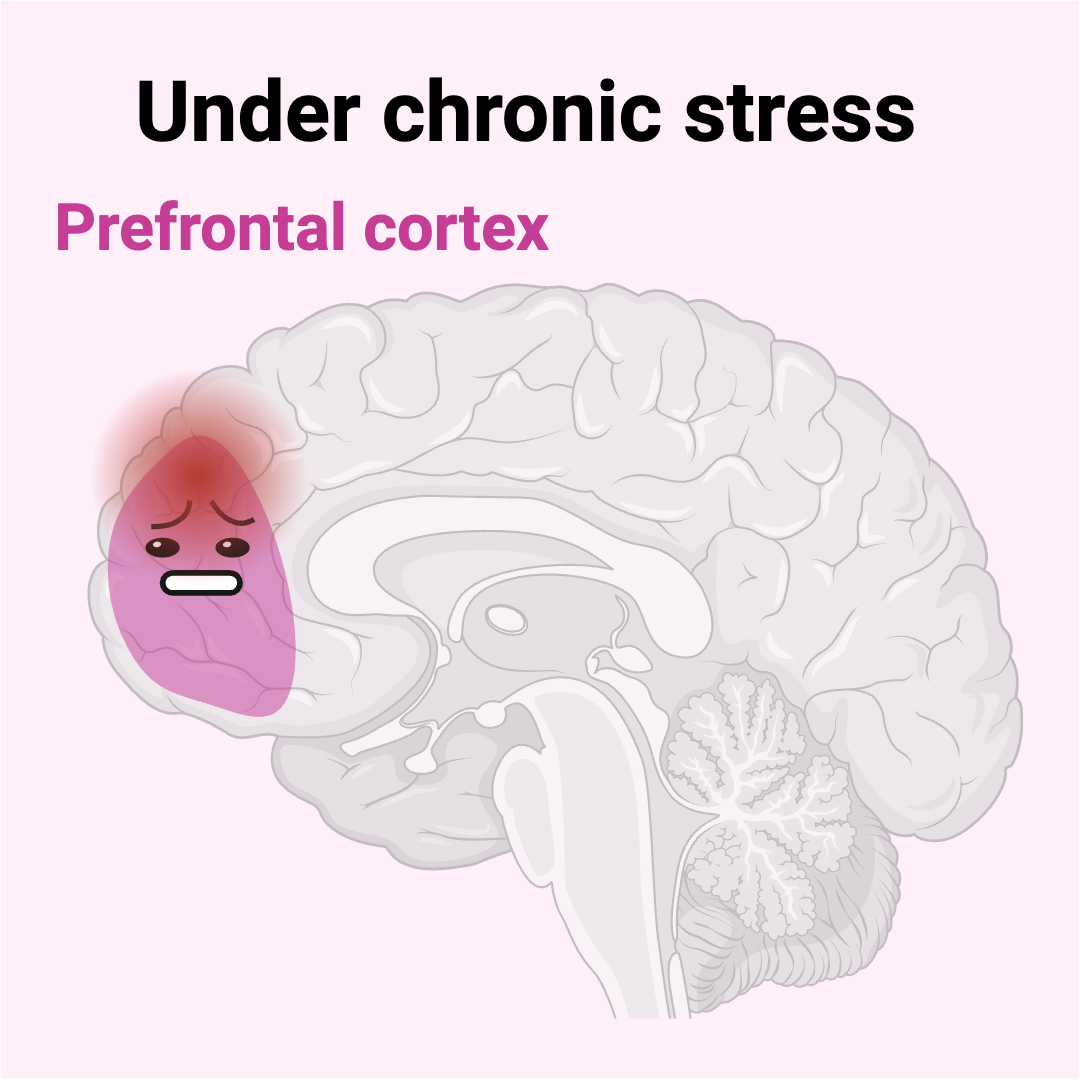
One way chronic stress makes daily function difficult is found in the prefrontal cortex of the brain. Just as the name indicates, this region is located at the front of the brain, just behind your forehead and eyebrows. The prefrontal cortex has a vital role in many of the more complex functions our brain performs, such as making decisions, attention control, planning, social cuing, and maintaining our working memory, or the use of information for a short period of time (Fig. 2). In response to stress, hormones and neurotransmitters known as catecholamines are released and chronic elevated levels of these chemicals disrupt normal signaling in the prefrontal cortex, weakening its function and eventually leading to structural changes such as the loss of neural connections (Kuipers SD et al, 2003; Radley JJ et al, 2015; Woo et al, 2021). An individual with a prefrontal cortex that has been affected by long-term stress can fall victim to difficulties with complex brain function, such as decision-making, working memory, and attention control (Fig. 3). Research also suggests that reduced volume or altered activity in the prefrontal cortex is associated with a higher likelihood of anxiety and depression, although this relationship is not purely causal (de Araujo Costa et al, 2017).
.png)
Fig. 2. Prefrontal cortex is responsible for decision-making, attention, social interactions, and the maintenance of working memory.
It may cause trepidation to consider the consequences of chronic stress. However, stress can be managed! Implementing stress reduction strategies is a simple way to maintain good health and peak brain function. Several examples of stress reduction techniques include regular exercise, maintaining a consistent sleep schedule, mindfulness, journaling, balanced nutrition, and taking time to enjoy hobbies. The key is to identify what strategies work best for each individual and then consistently implement them into daily life. Brain health matters, and it is crucial to make it a priority. Just a few simple changes can be invaluable to an individual’s mental health. The key takeaway: You are in charge - not the stress.
.png)
Fig. 3. Under chronic stress, prefrontal function is impaired, affecting decision-making, attention, social interactions, and memory.
Acknowledgment
Marijke Johnson is a Doctor of Physical Therapy student at ISU. This article is the result of a research literature project led by Dr. Lizbeth de la Cruz (Biological Sciences). It was edited, reviewed, and prepared with additional contributions from Dr. Sherry Adams (Biological Sciences). Logan McDougall provided feedback to strengthen the writing. Figures were created by BioRender.
References
- Arnsten AFT. Stress signalling pathways that impair prefrontal cortex structure and function. Nat Rev Neurosci, 2009, 10:410-22. DOI: 10.1038/nrn2648
- de Araújo Costa Folha OA, Bahia CP, de Aguiar GPS, Herculano AM, Coelho NLG, de Sousa MBC, Shiramizu VKM, de Menezes Galvão AC, de Carvalho WA, Pereira A. Effect of chronic stress during adolescence in prefrontal cortex structure and function. Behav Brain Res. 2017; 326:44-51. DOI:10.1016/j.bbr.2017.02.033.
- Kuipers SD, Trentani A, Den Boer JA, Ter Horst GJ. Molecular correlates of impaired prefrontal plasticity in response to chronic stress. J Neurochem. 2003; 85:1312-1323. DOI:10.1046/j.1471-4159.2003.01770.x.
- Radley JJ, Morilak DA, Viau V, Campeau S. Chronic stress and brain plasticity: mechanisms underlying adaptive and maladaptive changes and implications for stress-related CNS disorders. Neurosci Biobehav Rev, 2015; 58:79-91. DOI: 10.1016/j.neubiorev.2015.06.018
- Woo E, Sansing LH, Arnsten AFT, Datta D. Chronic stress weakens connectivity in the prefrontal cortex: Architectural and molecular changes. Chronic Stress, 2021; 5:24705470211029254. DOI:10.1177/24705470211029254.